



Will a QR Code on Print Really Fail If It's Printed Too Small? Do You Need to Test Scan with a Phone Before Output?
When a QR code on printed material won't scan, it is usually not the code itself that is broken. In most cases, at least one of four things was not given enough margin: size, quiet zone, contrast, and print precision. Under common 2026 delivery practice, small items such as business cards often use a QR code side length of 15–20 mm; posters and display stands are estimated at roughly 10:1 based on scanning distance; the quiet zone around the code is about one quarter of the side length; dark codes sit on a light background; and placed images should be no lower than 300 dpi. If these four points are met, everyday materials can generally be recognized reliably.
Why a QR Code on Paper Is Harder to Scan Than One on a Screen
The same QR code may jump instantly on a phone screen but leave people repeatedly failing to focus when printed on paper. The difference is that a screen is a self-illuminating pixel grid with clean edges and direct contrast. Printing presses ink dots onto paper fibers, and tiny modules can be swallowed by dot gain, paper ink absorption, and surface glare. A QR code's built-in error correction level—commonly L, M, Q, and H, with recoverable damage of roughly 7% to 30%—can make up for some loss, but it cannot fix structural problems such as being too small or missing a quiet zone.
So in projects, the common question is not 'Is this code made correctly?' but 'Can this code still be recognized reliably at this position, at this size, on this background?' The former is closer to aesthetics; the latter is closer to delivery. The rework cost when they fail is completely different.
- Screen scenarios: resolution adapts, changes are always possible, and scanning distance is close;
- Print scenarios: produced once, size and substrate fixed, and a change means a reprint or a sticker;
- Key difference: error correction handles 'local damage,' not 'overall too small, crowded on all sides.'
The Three-Part QR Code Layout Check: Set Size, Set Quiet Zone, Set Contrast
Based on 2026 project delivery habits, before a QR code goes to layout I check it against three dimensions in order, and I do not recommend reversing that order. Size determines whether it can be 'seen'; quiet zone determines whether it can be 'framed'; contrast determines whether it can be 'read.' If any one fails, the others being sufficient will still be dragged down.
- Set size: First confirm the scanning distance, not whether the design looks good. For close-range scanning (within 30 cm, such as business cards and single-page sheets), a side length commonly starts at 15–20 mm. For medium distance (1–3 m, such as posters and display stands), use the experience range of roughly 10:1, meaning about 1 m of distance corresponds to roughly 100 mm. For longer distances or complex lighting, test on site before deciding.
- Set quiet zone: The blank space around a QR code is usually reserved at about one quarter of its side length. This area should stay a solid color and should not be covered by text, images, trim marks, or bleed.
- Set contrast: Prefer a dark code on a light background. If you need a reversed code, make sure the light-dark contrast is strong enough and avoid dark backgrounds built from four-color overprint; otherwise print color shift will reduce contrast further.
The caution for each step is different. When setting size, ask 'Where does the person stand to scan, and for how long?'—not what size the designer finds harmonious. When setting the quiet zone, treat it as part of the QR code, not blank space that can be casually occupied. When setting contrast, judge by the printed result; being clear on screen does not mean it can be read on paper.
Beyond Size, Print Precision and Material Take Another Cut
Being large enough does not guarantee it will scan. A QR code is made of many small modules, and the smaller the modules, the higher the print precision required. The same code enlarged to a large format has bigger modules and is easier to print. But if you cram a very long link into a small size, the modules become extremely fine, and once dot gain blurs them, they cannot be recognized. A common fix is to switch the landing page to a short link before generating the code, reducing module density at the source.
A common scene in project delivery: the client gives a long link and a background image with texture, the designer overlays the code and sends it to output, and after the poster is put up, it scans from close range but fails two steps back. The usual rework is to shorten the link, change the background to a solid block, increase the size, and re-output the whole set. The cost is a full reprint or an extra layer of adhesive label. In typical ranges, this kind of design revision usually takes half a day to a day, and reprinting adds another print cycle.
- Paper: Paper with strong ink absorption tends to spread module edges; a common approach is to raise output resolution and confirm with a proof;
- Lamination: Gloss lamination reflects under strong light and interferes with recognition; for outdoor materials, matte lamination is common;
- Output: Placed QR code images should be no lower than 300 dpi; when conditions allow, generate directly in vector format;
- Background: A solid background is more stable than an image background; gradients or textured backgrounds noticeably lower the scanning success rate.
QR Code Acceptance Standard: What Counts as Qualified
Acceptance should not be based only on whether the layout looks good; it should be based on whether it scans. An actionable standard is: using an ordinary phone and common scanning software, at the material's actual use distance and under common lighting, several consecutive test scans all succeed on the first try. If it only scans from a specific angle or specific brightness, it does not meet the standard.
A common approach is to set two test points: print a test sheet of the layout at actual output size and scan it, then scan again on site after the proof or first article comes out. Only when both stages pass is the risk reduced to an acceptable range. Conversely, if the client provides only a mockup and asks to print directly, it is worth exporting the QR code separately and test-printing one sheet; this cost is usually low.
Applicable Scenarios and Boundaries
These rules suit materials that need long-term posting, batch printing, and clear scanning scenarios—such as posters, display stands, packaging, store materials, and business cards. Once printed wrong, rework goes through a reprint or supplementary print process. Based on experience ranges, the extra cost of a small-format supplementary print is usually a significant proportion of the initial printing fee, and the schedule must be rearranged, so spending ten extra minutes checking upfront is more cost-effective.
There are also cases where you do not need to follow the full set. If a QR code is used only on the day of an event and replaced afterward, or is shown only on screens and presentation decks where it can be changed at any time, you do not need to reserve a large layout area and a complete quiet zone for it. In scenarios where the scanning distance is very close and someone is guiding nearby (such as a cashier counter or check-in desk), the size can be tightened appropriately. The judgment standard really comes down to two things: whether this material can be changed conveniently, and whether someone is nearby to help the person scanning.
- Small items (business cards, single-page sheets): side length from 15–20 mm, quiet zone about one quarter of the side length, dark code on a light background;
- Medium items (posters, display stands): estimate size at about 10:1, and test at actual distance before layout;
- Outdoor (inkjet printing, light boxes, hoardings): enlarge further, prefer matte materials, avoid strongly reflective positions, and test with a proof or on the wall.
FAQ
If a printed QR code won't scan, is it a design problem or a printing problem?
In most cases, size, quiet zone, and contrast were not given enough margin upfront, and printing only amplifies the problem. Check the original file against the three-part layout method first, then decide whether a reprint is needed.
Can a reversed QR code (light code on a dark background) actually be used?
Yes, but it demands higher contrast and a better background. Avoid a dark background built from four-color overprint, test-scan a small proof first, and only then print in bulk.
If text slightly overlaps the blank space around a QR code, will it have an impact?
Occupying the quiet zone directly affects the scanning rate. The correct fix is to move the overlapping element or reduce the QR code as a whole, not to leave only a tiny margin as a compromise.
If the link is too long, is the QR code more likely to fail to scan?
The longer the link, the denser the modules, and the harder it is to print clearly at small sizes. A common approach is to switch to a short link before generating the QR code, which is lower cost and more stable.
Should I do a separate test scan before printing?
It is advisable to scan at least once on the layout file and once on the proof, using an ordinary phone and common scanning software, and test several angles and lighting conditions.
If you do only one thing: before final approval, print each QR code at its actual output size and stand at the distance where people will scan it for a test scan. This step costs almost nothing but can stop most reprints. Materials that can be changed at any time and have someone guiding the scan can be more relaxed. For materials that will be posted long-term and printed in batches, check each item against the ranges above, and if necessary have design and output confirm together. In project delivery, we usually complete this step before sending files to output.
-
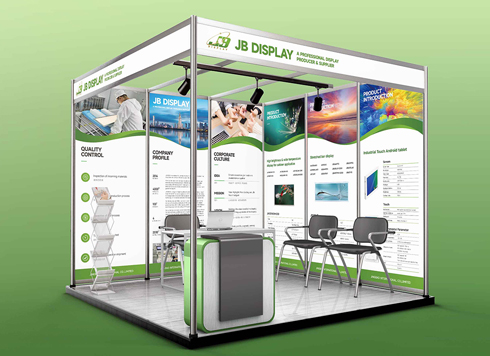 Booth Poster Design for Professional Monitor Product Suppliers
The standard exhibition booth poster projec ...
-
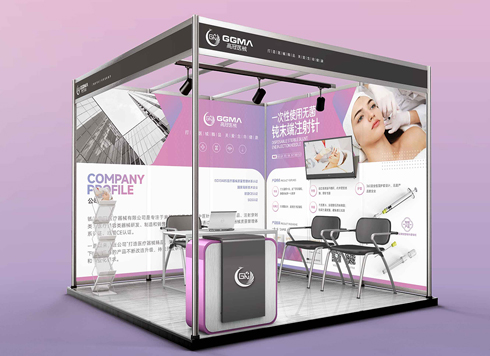 Design of Standard Exhibition Booth Posters for Beauty Instruments
Carefully designed a standard exhibition bo ...
-
 Design of Exhibition Posters for Medical Device Standards
XiYue is designing an exhibition booth post ...
-
 Collection of Brochure Design Cases in 2024 (Cover Series 02)
Our brochure design projects focus on diver ...
-
Poster QR code won't scan: is it too small or too close to the edge?
Date: Sep 12, 2026 Read: 11
-
Why does the same foil stamping look premium on someone else's brochure but cheap on mine?
Date: Sep 14, 2026 Read: 2
-
Large-area poster gradients print out in stripes — can adding noise alone fix it?
Date: Sep 13, 2026 Read: 6
-
Printed Black Text Looks Fuzzy with Color Fringing—Is Four-Color Black Really to Blame? Is It Necessary to Change Text Black Separately Before Printing?
Date: Sep 12, 2026 Read: 9
-
Is 7pt Text on Printed Materials Really Unreadable? Is a Full-Size Proof Before Printing Necessary?
Date: Sep 10, 2026 Read: 15