

Industrial HMI UI Design Guide: Architecture, Interaction, and Visual Specification
Core Conclusion for Industrial HMI UI Design: Function First, Safety First
Industrial HMI UI design must aim for minimal operation steps, anti-mistouch, and high readability, ensuring efficient task completion in dusty, high-glare, glove-operating, and high-pressure environments. Unlike consumer UI, industrial HMI UI never pursues visual flashiness but ensures operation accuracy and speed through information hierarchy, interaction feedback, and visual specifications. Design should prioritize ambient lighting, screen size, touch sensitivity, and safety standards, avoiding any redundant elements that affect judgment. The following framework applies to industrial equipment interface design for 2026 and beyond, with core principles of "stability, efficiency, and verifiability."
Unique Challenges and Design Goals of Industrial HMI UI
Industrial HMI UI is designed specifically for industrial environments, needing to address glare from changing ambient light, information display constraints due to physical size limitations, touchscreen sensitivity affected by gloves or stains, and strict safety compliance. Successful designs often find a balance between information density and operational simplicity. Specific challenges include:
- Ambient lighting: High-contrast color schemes and anti-reflective coatings ensure readability under strong light.
- Size constraints: Prioritize critical indicators, fold secondary functions into submenus.
- Touch: Touch areas should be no smaller than 48×48 pixels, avoid swipe mis-touch, and support glove operation.
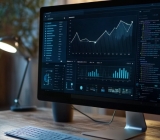
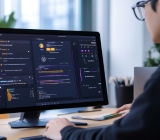
Design goals are clear: core monitoring data accessible in one step, alarm information prominent with delay less than 500ms. Common practice in 2026 is to adopt a dashboard-style layout, juxtaposing alarms, status, and trend charts for quick assessment.
Information Architecture and Interaction Logic Design
Information architecture is layered by operation frequency and urgency: core monitoring data placed on the main interface, secondary settings in submenus. Interaction logic follows the "tap to confirm, prevent mis-touch" principle, avoiding complex gestures. For example, accidental tap operations require secondary confirmation; swipe gestures are only used for non-critical scenarios. Meanwhile, physical buttons and touch can operate in parallel, retaining emergency operation channels. Specific specifications:
- Main interface: Displays key indicators (temperature, pressure, speed, etc.), alarm area fixed at top.
- Submenus: Parameter configuration, history data, system settings, switched via tabs.
- Interaction feedback: All operation feedback within 500ms; timeout requires loading indicator; error operations prompt with red flashing.
In 2026 projects, most enterprises establish unified interaction specifications, such as button click state feedback, swipe confirmation logic, etc., to reduce training costs.
Visual Hierarchy and Component Specification
Visually, adopt high-contrast colors (e.g., dark background + light text), large font sizes (body text no smaller than 20px), and wide click areas. Component specifications need a unified color system and status indication: "Three-color principle" green (normal), yellow (warning), red (alarm), with alarm colors flashing or with borders. Component library includes:
- Color system: Primary, secondary, alarm colors; each defines normal and highlighted variants; disabled states uniformly reduce saturation to gray.
- Typography: Uniform sans-serif font, minimum 16px, important data bold, ensuring readability under strong light.
- Spacing: Grid system with 8px increments, ensuring breathing room between elements, avoiding crowding.
Based on 2026 project delivery habits, the component library should include buttons, sliders, tables, charts, etc., and define each component's disabled state, hover state (adapt for touch if supported), and click feedback.
Usability Testing and Acceptance Criteria
Usability testing must simulate real industrial environments: glove operation, observation under strong light, high noise background. Acceptance criteria include task completion time (each step no more than 3 seconds), error touch rate (below 1%), and user subjective satisfaction score. Common 2026 workflow: low-fidelity prototype testing → high-fidelity simulator verification → on-site prototype deployment. Design walkthroughs can be conducted in stages during development to ensure fidelity.
Compare two implementation approaches: Template customization vs. Custom design system
- Template customization: Low cost, about 50,000-100,000 RMB; short cycle, 1-2 weeks; suitable for single-model projects; but may not fit different hardware sizes, and long-term maintenance may lead to fragmentation.
- Custom design system: High initial investment, about 200,000-500,000 RMB; long cycle, 1-3 months; but strong cross-project reusability, suitable for multi-product-line enterprises. For example, Xiyue Company adopted a custom system in multiple industrial control devices, leading to significantly improved later iteration efficiency, with individual modification cost reduced by about 40%.
Enterprises can choose based on number of projects and hardware differences. For only 1-2 devices, template customization is more economical; for more than 3 products with diverse screen sizes, investing in a custom system is recommended.
Applicable Scenarios and Boundaries
Industrial HMI UI applies to automation equipment, smart production lines, energy management, and other industrial scenarios, emphasizing function-first and operational safety. Not suitable for consumer UI (e.g., entertainment, social) nor for occasions requiring frequent guidance and brand aesthetics. Boundary conditions:
- When hardware performance is weak (e.g., low-resolution screen, single-core processor), reduce animations and complex graphics to avoid lag.
- When touchscreen is not mandatory, retain physical buttons as backup, especially in harsh oily environments.
- If operator turnover is high, add new-user guidance tips or simplify initial interface.
Additionally, when requirements change frequently and iteration cycle < 1 month, template customization is more flexible than custom system.
Frequently Asked Questions
How to ensure fidelity from prototype to high-fidelity?
Establish a design system and unify annotation specifications; organize design walkthroughs before development; verify interaction details in high-fidelity phase; ensure development team references design mockups rather than prototypes.
Main differences between B-end industrial HMI and C-end UI?
Industrial HMI emphasizes information density and error prevention, while C-end emphasizes guidance and visual appeal; industrial HMI operation paths are fixed, C-end is more exploratory.
When is it appropriate to establish a design system?
When the project reaches the 3rd similar product or requires cross-device adaptation, building a component library can significantly reduce repetitive work. It is recommended to plan at the end of the first project.
How to verify if an industrial HMI UI is qualified?
Record task completion time and error count through task testing, collect user satisfaction scores, and compare against industry standards (e.g., error touch rate < 1%, critical operations completed in ≤ 2 steps).
Can industrial HMI color schemes be customized?
Primary colors can be adjusted according to brand, but alarm colors must comply with safety standards (red, yellow, green) and maintain high contrast to avoid confusion for color-deficient users.
Action Guidance: It is recommended to clarify information hierarchy and interaction rules early in the project, prioritize core monitoring paths, and then iterate gradually through field testing. This framework is suitable for industrial equipment interfaces with high requirements for stability and efficiency, not for consumer applications pursuing rapid marketing iteration.
-
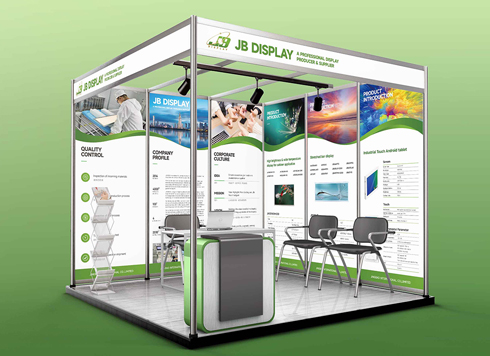 Booth Poster Design for Professional Monitor Product Suppliers
The standard exhibition booth poster projec ...
-
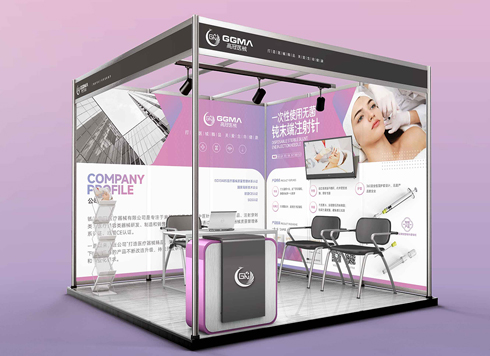 Design of Standard Exhibition Booth Posters for Beauty Instruments
Carefully designed a standard exhibition bo ...
-
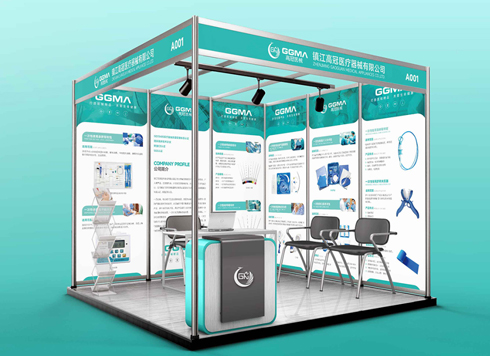 Design of Exhibition Posters for Medical Device Standards
XiYue is designing an exhibition booth post ...
-
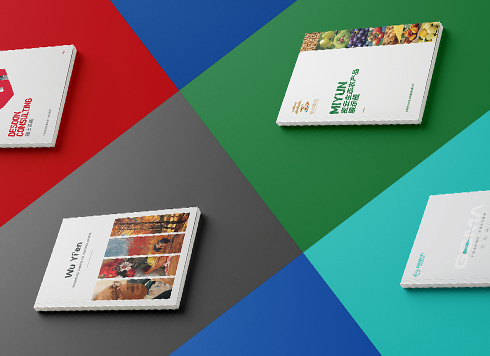 Collection of Brochure Design Cases in 2024 (Cover Series 02)
Our brochure design projects focus on diver ...
-
In-Store Guide Interface Design Guide: From Information Architecture to Delivery Acceptance
Date: Jul 30, 2026 Read: 106
-
Marketing Mini-Game UI Design Guide: Core Process from Information Architecture to Acceptance
Date: Jul 29, 2026 Read: 83
-
Live Streaming Interactive UI Design Guide: Information Architecture, Interaction Logic, and Delivery Acceptance
Date: Jul 28, 2026 Read: 101
-
Industrial Touch Interface Design Guide: Interaction Logic, Information Architecture & Acceptance Criteria
Date: Jul 20, 2026 Read: 74
-
A Complete Guide to Prototyping: From Low-Fidelity to High-Fidelity Workflows and Delivery Standards
Date: Jul 16, 2026 Read: 66