




How Many Rounds of Revisions Are Normal for Graphic Design? What Details Are Often Overlooked in Delivery?
How many rounds of revisions are normal for graphic design? Based on 2026 project delivery practices, the typical range is 4 to 8 rounds, divided into four stages: concept, first draft, refinement, and finalization, with 1 to 2 rounds of feedback reserved for each stage. Fewer than 4 rounds may indicate that the requirements haven't been fully aligned; more than 8 rounds likely mean there are issues with requirement articulation or acceptance criteria. When delivering the final work, in addition to source files, details such as font embedding, image resolution, color mode, and bleed must be checked. Missing any of these can cause problems in print or online launch. Based on years of project execution experience, this article explains revision rounds, acceptance checklists, and copyright boundaries all at once to help you avoid pitfalls.
Why Are Revision Rounds Increasing? First Ask Whether Requirements Are "Verifiable"
The root cause of losing control over revision rounds is often that requirements remain at the "feeling" level. When the client says "make it more impressive" or "make the color brighter," the designer can only guess. Based on project management experience, for a requirement to become executable design instructions, it should at least include the audience, context, style references, mandatory elements, and forbidden elements. Without these four categories of information, revisions are blind. The experience range is: if a requirement sheet cannot ensure that "every feedback maps to a specific location and degree," revision rounds usually exceed 8.
Making requirements "verifiable" means that every piece of feedback can be mapped to a specific location and effect. For example, "increase the main title font size by one level" or "change the background from white to light gray without affecting body text contrast." Only when this is achieved does revision have an endpoint. Otherwise, the project will fall into a loop of "changing again and again, only to return to the first version."
- Non-verifiable feedback: "It doesn't feel premium enough" or "make it more prominent" — without location and degree, the designer cannot determine when it's done.
- Verifiable feedback: "Change the title to two lines, increase letter spacing by 2pt" or "shrink the illustration by about 10% without blocking the right-side copy" — each revision has a clear objective.
What Counts as "Final"? Three Hard Criteria
Final does not mean "the image is done." According to common practice in the design industry, a design draft is considered "final" only when it meets three criteria: correct direction, complete details, and usable format. Correct direction means that the information conveyed on the page and the visual style match the requirement sheet; complete details means checking whether fonts are embedded, images are high-resolution, and bleed and trim marks are included; usable format means the file can be directly used for printing or online release, rather than being just a mockup. The experience range is: to fully satisfy all three criteria, it is usually necessary to set aside half a day to a full day for a dedicated check.
These three criteria are also the baseline for acceptance. If any one of them is not met, no matter how good the design looks, it cannot proceed to delivery. Counter-example: a project was only told by the printing house about missing fonts after finalization, which cost an extra 1 to 2 days to re-output, plus an additional rush fee. The experience range for such rush fees is 500 to 1,500 CNY, depending on how busy the local printing house is.
- Correct direction: whether information hierarchy, stylistic temperament, and color tone match the approved draft.
- Complete details: whether fonts are outlined or embedded, images are at least 300dpi, and bleed is reserved according to the printer's requirements.
- Usable format: whether file format and color mode match the output purpose, such as CMYK for print and RGB for screen.
A Four-Step Final Check Method: Before Starting, After First Draft, During Refinement, and Before Finalization
To reduce the embarrassment of "thinking it's final when it's not," our project team has summed up a four-step check method from long-term delivery experience. It breaks the finalization judgment into four time points, with each step focusing on one thing, to avoid piling all issues until the end. The experience range for this method is: if followed, revision rounds per project can be controlled within 6 rounds, on average 2 to 3 rounds fewer than projects that do not follow a process.
- Before starting: clearly write down design objectives, deliverable formats, revision limits, and ownership of source files.
- After the first draft: discuss only direction, not details. First confirm whether the overall direction of style, composition, and color scheme is valid.
- During refinement: focus on details, such as letter spacing, image sharpness, and alignment, with each round of feedback listing only specific issues.
- Before finalization: check against the delivery checklist item by item, including file naming, color mode, bleed, and editability.
The core of this method is to "separate feedback into streams." Directional issues are resolved first, detail issues later, and finally only format checks are done. If the order is reversed, you'll be nitpicking details in the first draft and then overturning the direction later, which will inevitably lead to many revision rounds. A common project situation is: composition issues are not raised in the first two rounds, but only after finalization do they say "the background photo is wrong," resulting in a complete redo and a deadline delay of two days or even a week. Based on experience, the typical range for cost increases caused by such delays is 20% to 40% of the total project fee.
Delivery Checklist: What Else Is Missed Beyond Source Files?
Many clients think that delivery simply means getting a JPG or PDF, but based on 2026 project delivery practices, a qualified delivery package should include at least: editable source files, PDF with text outlined, instructions on embedded or outlined fonts, high-resolution image assets (layered source files are needed if original illustrations are used), and color configuration files. If any of these is missing, future modifications will require finding someone new, possibly incurring extra costs. The experience range for such additional costs is 300 to 2,000 CNY, depending on the complexity of the modification.
Special reminder: source files are not "just handed over." You need to check whether they are in an editable version. Some designers provide messy ungrouped layers or rasterized fake source files. During acceptance, open the layers and font lists to confirm that everything works properly.
- Editable source files: AI, PSD, Figma links, etc., with clear layer structure and no dependency on missing assets.
- Output files: PDF or images, with dimensions, resolution, and color mode matching the intended use.
- Asset files: images, icons, font files (or a list of font names) to avoid future modification difficulties.
- Color specification list: CMYK and RGB values for brand colors and secondary colors, for consistency across other materials.
Revision Rounds and Copyright Boundaries: Flat Fee per Round or Billing by Hour?
Disputes over revision rounds usually arise from not agreeing on the pricing method in advance. There are two common approaches: flat fee per round and billing by hour. Flat fee per round sets a total price that includes a specific number of revisions, with extra charges for changes beyond that; billing by hour charges separately for the actual time spent on modifications, suitable for projects with many requirement changes. Each method has its applicable scenarios.
If requirements are clear, a flat fee per round is recommended for easier budget control; if requirements are still being explored, billing by hour is fairer. On copyright, a common agreement is: after full payment, the copyright of the source files is completely transferred to the client; if the final payment is not made, the designer has the right not to provide editable source files. Here is an experience range: for flat-fee-per-round projects, the typical range for a single revision fee beyond the included rounds is 10% to 20% of the total project fee; for hourly billing projects, the typical hourly rate range is 200 to 800 CNY, depending on the designer's seniority and the city.
Applicable Scenarios and Boundaries
This "final acceptance standard" is more suitable for one-time design commissions, such as posters, brochures, packaging fronts, and e-commerce detail pages. It allows both parties to align expectations before starting work, reducing end-of-project friction. For full brand projects and VI systems, more detailed phase reviews are needed, and relying solely on a few rounds of revisions may instead limit creative space.
Conversely, if the project is merely temporary collaterals, or the budget is extremely low (less than half of the designer's minimum fee), it is not necessary to apply the full process. Simply setting a fixed number of revisions, such as "includes two minor changes, with additional charges per change," is sufficient. Boundaries should be written into the requirement sheet: it does not include animation production, print supervision, or copywriting. This boundary description can avoid later disputes.
FAQ
Is fewer rounds of revisions always better?
Not necessarily. If the requirements are complex, such as a full brand project, even a dozen rounds may be normal. The key is to clearly define "what counts as one revision" before starting work, to avoid counting minor adjustments as a full round.
Do source files have to be provided? Is charging extra reasonable?
If the contract states "deliver all source files," then no additional charge should be made; if it only says "final artwork," it is common practice to price source files separately. It is recommended to confirm this before starting.
When checking the design, should I focus on color or layout?
First check whether the layout and information hierarchy match the approved draft, then check whether colors are within a normal display environment. For printed materials, you must review a proof; screen display is only a reference.
What should I do if the number of revision rounds exceeds the agreement?
Pause first and re-review the requirement sheet to determine whether it is a requirement change or a design quality issue. If it is a new requirement, it can be billed separately; if it is a quality issue, the designer should rework it without additional charge.
Is there a universal acceptance standard in 2026?
There is currently no unified industry standard, but you can use built-in checks in design software and print house proof reports to assist judgment. It is recommended to include the acceptance checklist in the requirement sheet.
Spending half an hour confirming the acceptance checklist before starting work is more efficient than spending three days on disputes at the end. Based on project experience, writing revision rounds, deliverable files, and copyright ownership into the requirement sheet will significantly reduce the likelihood of project delays and price increases. If your project is still in the vague requirement stage, compress the reference images and text requirements into three sentences: who is the audience, where will it be used, and what must be communicated.
-
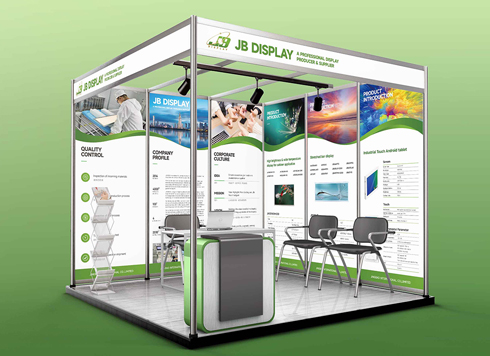 Booth Poster Design for Professional Monitor Product Suppliers
The standard exhibition booth poster projec ...
-
 Design of Standard Exhibition Booth Posters for Beauty Instruments
Carefully designed a standard exhibition bo ...
-
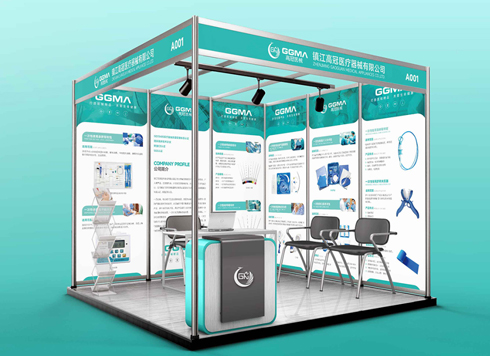 Design of Exhibition Posters for Medical Device Standards
XiYue is designing an exhibition booth post ...
-
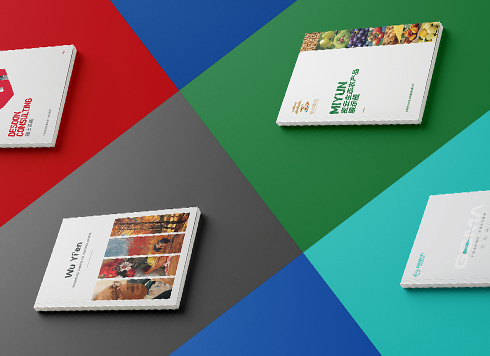 Collection of Brochure Design Cases in 2024 (Cover Series 02)
Our brochure design projects focus on diver ...
-
The logo is centered in the circular button, so why does it still look off to one side? Should I nudge it manually, or is something wrong with the file?
Date: Oct 15, 2026 Read: 1
-
Same logo looks clear in a brochure—why does it blur on a shipping box? Can switching the file to a box version save it?
Date: Oct 14, 2026 Read: 3
-
Brochure body text justified with uneven letter spacing and white gaps at line ends—is the software stretching the spacing? Will left alignment fix it?
Date: Oct 13, 2026 Read: 7
-
White Logo on Black Card Packaging Looks Gray—Was White Ink Printed Only Once? Will One More Pass Fix It?
Date: Oct 12, 2026 Read: 9
-
Why does a folded crease always crack with a white line first—is the paper too thick or the crease not scored deep enough?
Date: Oct 11, 2026 Read: 12